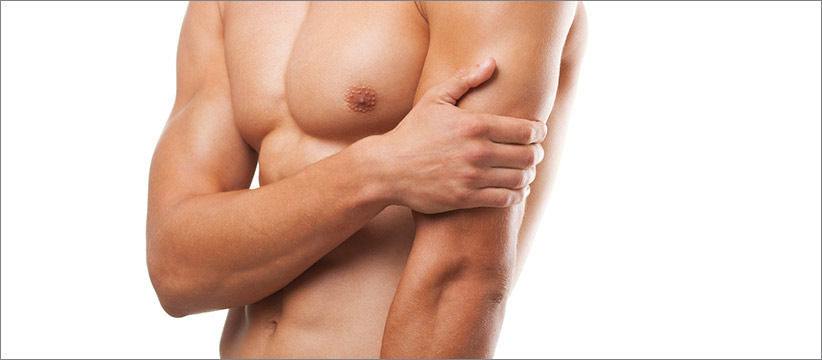
Gynecomastia Surgery (Male Breast Reduction)
Gynecomastia (sometimes spelt gynaecomastia) is a relatively common but emotionally distressing condition, causing prominent male breasts or “man boobs”. Gynecomastia surgery using a variety of cosmetic surgery techniques is one of the most effective treatments for reducing this condition.
Gynecomastia (enlargement of the male breast tissue) is a condition which can run in families. It can be made up of excess glandular tissue, fatty tissue or excess chest skin (in varying ratios).
Aurora is now part of The Private Clinic, please click here to find out more about Gynecomastia – Male Chest Reduction and The Private Clinic. World renowned plastic surgeon Mr Adrian Richards is part of The Private Clinic expert team.
There are some medical causes of gynecomastia which include: the use of certain drugs (i.e. marijuana, smoking) and conditions such as liver disease. Some other causes are associated with weight gain. If you are concerned that you may have gynecomastia, it would be of benefit to reduce your weight as this may improve the situation. If you are taking any medications such as steroids, these can also make the problem worse so should be stopped if possible. In most cases, however, the gynecomastia is idiopathic (meaning ‘no cause found for the condition’).
Considering Gynecomastia Surgery?
There are many reasons why men of all ages and physical builds seek a surgical solution. Some common factors which influence their decision include:
- Embarrassment, particularly when changing in public
- Problems with sexual relationships
- Unhappiness with physical appearance and outline in clothing
- Emotional conflict over sexual identity
There are various different methods for treating gynecomastia. These depend on the area, tissue composition and degree of severity. The options range from exercise to painkillers and surgical treatment in severe cases. The surgical options include liposuction or excision or a combination of both.
How will it impact on your life?
As a man, having prominent breasts can be quite disconcerting. It can be very embarrassing when changing in public, especially as a young man potentially still at school. This can lead to bullying and teasing which can leave emotional scars later in life. You could have problems in your sexual relationships, and lack the confidence to enter into a relationship. You could also be unhappy with your physical appearance, and how your clothes sit. We find people tend to wear baggy clothing to try and cover the gynecomastia.
The aim of this surgery is to reduce this prominent breast tissue and achieve a more natural contour to your chest area to increase your self-esteem and make you feel comfortable with your physical appearance.
Male Breast Reduction FAQs
Puffy nipples are common gynecomastia symptoms, where glandular tissue is enlarged just in the area of and around the male areola causing a swollen, protruding look to the nipples.
In the vast majority of cases there is no specific cause. This is known as idiopathic gynecomastia and it is normally down to the pattern of fat distribution in individuals. Such conditions often run in families, with fathers and sons having similar patterns of fat distribution in the chest area.
It is quite common for males to develop prominent breasts during puberty as increasing hormone levels cause one or both breasts to develop unevenly. As many as 90% of adolescent males experience this but the problem usually settles down with maturity. In approximately 10%, however, the condition continues into adulthood as gynecomastia.
Gynecomastia can, itself, be a symptom of other underlying health issues or (rarely) more serious syndromes:
Lifestyle gynecomastia causes
- Excessive alcohol consumption
- Marijuana use
- Steroid use
- Hyperthyroidism
- Hypogonadism
- Kidney or liver failure
- Liver disease
- Medication side effects from hormone treatments, chemotherapy, radiation therapy and certain medications
- Tumours of androgen-producing glands
- Syndromes such as Klinefelter’s Syndrome (a condition where a male has an extra X chromosome)
The normal values lie between 20 and 25 depending on your body frame. For example for a 70kg man, the average height is approximately 1.76 metres.
| BMI Level | Weight Measurement |
| Below 20 | Underweight |
| 20 - 25 | Normal weight |
| 26 - 29 | Slightly overweight |
| 30 - 39 | Significantly overweight |
However, if you do suffer from excess skin on your chest, you may still be a good candidate for cosmetic surgery to treat this problem. Male breast reduction surgery at Aurora Clinics uses a variety of techniques and excisional techniques are particularly good for dealing with excess skin. Fatty tissue causing gynecomastia-type symptoms may respond better to liposuction techniques (after an initial program of exercise).
‘True’ gynecomastia symptoms, of enlarged glandular tissue tend to require a combination of liposuction and excision. Your surgeon is the best person to advise you about the best course of treatment for you during your consultation.
- Your gynecomastia, including any social difficulties such as swimming and wearing tight clothing
- They will then enquire about your health and any medical issues, such as medications and lifestyle habits which can contribute to gynecomastia
- Your surgeon will also assess your body mass index (BMI) to ensure it is within normal boundaries. If it is over 25, your surgeon will recommend a program of exercise and diet to lower your BMI, as it can have significant impacts on the fatty distribution within the breast tissue
- If your surgeon has ruled out any underlying cause for your gynecomastia and you are of normal weight they will discuss the various available options for treatment
- You will be encouraged to express your concerns and your reasons for considering surgery
- Location and size of any scars
- The likely amount of reduction of your gynecomastia
- Aftercare, particularly the type of support clothing and dressings that you will wear afterwards
- Your recovery time
- Which activities you can perform after surgery
- Possible complications that can occur following surgery
This will give you the best possible idea of the result of your surgery, likely scarring and also the amount of reduction of the chest area that can be achieved. It is important to remember, however, that scarring varies between individuals and your surgeon will make sure you have a full understanding of how the scars could appear. We would also advise that you see the results of the surgery from different angles, including:
- a full frontal photograph
- a ¾ photograph and
- a photograph from the side
- Liposuction alone should produce minimal scars in the chest area
- Liposuction with excision of breast tissue usually involves a semicircular scar below the brown area of the nipple where it meets your normal coloured skin
- Liposuction, excision of breast tissue and removal liposuction normally creates a scar all the way around the edge of where the areola meets your normal coloured skin
If your male breasts are identified as being composed mainly of fatty tissue and you are overweight, certain gynecomastia exercises may be of benefit. Gynecomastia surgery is not suitable for men who are above their recommended BMI, so if you are overweight it may be worth trying these exercises to see whether you notice any improvement before considering further action.
Compression garments can hide chest deformity and stabilize bouncing tissue, bringing some emotional relief and physical comfort. If your male breasts are tender as a result of gynecomastia, cold compresses may be applied. Pain relievers may also be taken. If experiencing pain, it is recommended that you contact your GP for a clinical evaluation.
Other than reaching your optimum physical health, trying to hide the problem and pain relief, for those with true gynecomastia, surgery is often the only option.
Essential cardiovascular exercises combined with a good diet that reduces body weight can improve the appearance of gynecomastia by reducing the fatty content of the breast tissue. However, for cases of gynecomastia where the tissue composition is mainly glandular, exercise is unlikely to have a great deal of effect. Nonetheless, it is always worth trying exercise first as it can only be of benefit to reach your optimum weight before attempting to resolve other health or physical issues.
Unfortunately no amount of specific chest exercises will affect the overlying breast tissue which causes gynecomastia. In fact, gynecomastia can often be made worse by rigorous and extensive chest exercises which cause the breast tissue to push forward.
Treatment for mainly fatty gynecomastia with little breast tissue and no skin excess. If your gynecomastia is mostly composed of fatty tissue without a significant central area of breast tissue and you are of a normal weight, it is likely that it is caused predominantly by an accumulation of fatty cells. The best treatment for this is liposuction to remove the fatty tissue. The advantage of liposuction is it involves minimum scarring and there is a relatively quick recovery.
Treatment for gynecomastia with both fatty and breast tissue elements. Gynecomastia without skin excess but with a significant central area of breast tissue is best treated with liposuction to reduce the fatty element to the breast, combined with an incision underneath the nipple to access and remove the central area of breast tissue.
Excess skin and gynecomastia composed of fatty tissue and breast tissue. If you have loose skin in the chest area combined with fatty and excess gland tissue the best treatment is to remove the fat with liposuction, the gland with excision and to tighten up the skin by removing a segment through excision.
There are a number of gynecomastia treatment options available in the UK if you are embarrassed by enlarged male breasts. However, due to the complex nature of diagnosing gynecomastia, identifying your unique breast tissue composition and selecting the best course of treatment for you, it is always recommended that gynecomastia treatment is undertaken following a consultation with an expert.
- Tumescent liposuction
- Vaser liposuction
- Smart liposuction
- Power-assisted liposuction
In tumescent liposuction, fluid is injected to help dissolve the fatty tissue, whereas in vaser therapy, sound energy is used to disrupt the wall of the fat cell making it easier to remove via suction. Smart liposuction is a less invasive form, using a laser on small localized areas. And power-assisted liposuction uses a vibrating cannula to loosen fat cells from the body for easier suction.
Advantages of the liposuction technique:
- It is a relatively simple procedure to perform
- It involves minimal scarring
- The recovery period is relatively quick
- Liposuction techniques only remove the fatty element of breast tissue and do not remove the breast gland. If the breast gland is the principle cause of gynecomastia this will not be removed with liposuction and some gynecomastia can remain.
- Over time, enlargement of the male breast tissue generally stretches the skin. Liposuction techniques remove the fatty elements within the breast and rely on natural skin contraction to tighten the skin. Skin tightening only occurs to a limited extent and tends to occur more in younger people. Therefore, liposuction techniques only deal with relatively modest amounts of skin excess.
- In excisional gynecomastia surgery, your surgeon will make a cut in your breast to access the breast tissue. This cut is usually located around the outside of your areola (the round area around the nipple).
- This allows the surgeon to directly access the breast tissue and remove any excess tissue from the breast area.
| Pros | Cons |
|---|---|
| More ability to remove the breast tissue as well as the fatty tissue from the breast. | Involves more scarring than liposuction, which is normally located around the nipple. |
| It also has the ability to tighten up the stretched skin of the breast area. |
Recovery from the excisional technique is slightly longer because of the incision around your nipple area. Your stitches may need to be trimmed around one week after your operation. You may also need to wear a support garment in the same fashion as if you had liposuction.
This procedure is considered permanent however it is possible for your gynecomastia to recur if you put on weight following surgery.
- It is important to achieve a normal weight before any surgery for gynecomastia: gynecomastia surgery is NOT a solution if you are carrying excess weight
- You need to discuss with your surgeon which type of surgery is most appropriate for you
- Following excisional surgery and liposuction you will have scars on your chest which (although they will fade) will be permanent. The scarring from surgery varies from different techniques and may involve a semicircular scar at the bottom of the brown area of the nipple (areola) at the junction with the skin
- If more of the skin needs to be removed, the scar may stretch all around the nipple, allowing your surgeon to remove a doughnut area of skin and pull it inwards. For more severe gynecomastia, scars may be required on the normal chest skin itself, although this is normally avoided if at all possible.
The next step
We always encourage people to do as much research as they can when considering cosmetic surgery, so for more information on gynecomastia surgery:
- Read our online Trust Pilot and Real Self reviews
- Watch our surgeon videos covering frequently asked questions
- See before and after photographs in our extensive gallery to compare and contrast results with your body shape
- Get in touch and we will email you information on our surgeons and clinics and how to book a no obligation consultation.